A wood deck that isn’t protected doesn’t stay that way for long. Central Texas runs the full spectrum of a deck’s worst enemies: UV that bleaches and dries wood faster than almost anywhere in the country, spring humidity that pushes moisture into every grain and fastener, and clay soil that moves seasonally and shifts the joints and gaps where water gets in. Untreated wood in Central Texas behaves a lot like unprotected skin in the sun. The damage starts immediately, even if you can’t see it yet. At Apex Deck Builders, deck staining and sealing is the maintenance service we do most, and the one homeowners say has the most visible impact per dollar spent.
Get a free staining estimate, and we’ll come out, assess your deck’s current condition, and recommend the right stain type and timeline for your specific wood, your sun exposure, and your goals. No pressure, no upsell to unnecessary prep work.
Request A Free Quote
Most homeowners call us for deck boards, but a properly protected outdoor space means treating every exposed wood surface.
Deck boards are the primary surface, and where the most visible wear shows first. We stain every board, work the product into end-grain cuts, and pay particular attention to areas near drainage points and under furniture, where water sits the longest. For decks with built-in seating or planter boxes, we also stain the contact surfaces.
Railings and balusters take a different exposure than horizontal surfaces. They face direct sun on more sides, and they’re the first place homeowners notice fading. We handle railing staining and color matching to ensure the entire structure reads as a cohesive finished project rather than a freshly stained deck with weathered rails.
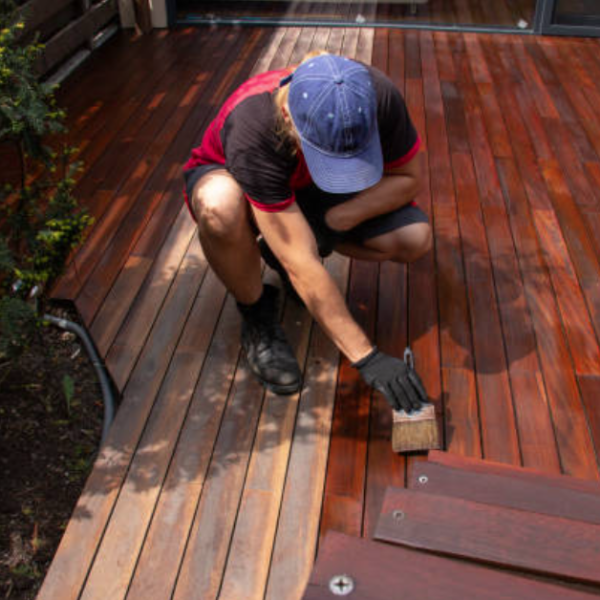
Stairs are among the highest-wear surfaces on any deck. Foot traffic wears the finish down faster than open deck boards. We apply an appropriate finish weight and product type for stair treads specifically.
Pergolas and shade structures see UV exposure from every angle. We handle pergola staining for freestanding and attached structures as part of a comprehensive project or as a standalone service. The same applies to outdoor living surface staining for built-in benches, privacy screens, planter boxes, and other wood elements that are part of the outdoor living space.
Getting the stain choice right matters as much as the application. The wrong product on the wrong wood type in the wrong exposure level fails faster than it should, and fixing a bad stain job is more work than starting from scratch on bare wood.
Transparent stains show the full grain and natural color of the wood. They provide the lightest level of UV and moisture protection and are best suited for newer decks in premium wood species like cedar or redwood where the natural appearance is the point. They need reapplication on the shortest cycle of the three finish types, typically every one to two years in full-sun Central Texas conditions.
Semi-transparent stains add a wash of color while still letting the wood grain show through. They offer moderate UV and moisture protection and work well for most deck types and ages. This is the finish type we recommend most often for cedar and pressure-treated pine decks that are in sound condition and want a balance of protection and natural appearance.
Solid stains offer maximum coverage and protection. They effectively paint the wood surface with a penetrating pigment that hides grain, color variation, and most minor surface defects. They’re the right choice for older decks with significant weathering or color variation that a semi-transparent finish won’t cover, and for pressure-treated pine decks where the natural appearance of the wood isn’t the priority.
Beyond finish type, wood species determines product selection and application method. Cedar and wood deck surfaces in cedar, redwood, and Douglas fir absorb stain readily and respond well to oil-based and water-based products. Pressure-treated pine is denser and requires a different product formulation to penetrate the treatment chemicals already in the wood. Ipe and tropical hardwoods are the most challenging. They’re extremely dense, have natural oils that resist penetration, and require specific prep to get consistent coverage. We work with all of them and select the product based on the actual wood we’re treating, not a standard offering.
Homeowners sometimes ask whether their deck should be stained or painted. For most wood decks in Central Texas, stain performs better over time than paint.
Stain penetrates the wood fiber and protects from within. Paint sits on the surface. In Central Texas heat, the paint film expands and contracts more aggressively than the wood beneath it, causing peeling and cracking that require full stripping before repainting. A failed paint job on a deck is significantly more labor-intensive to remediate than a faded stain coat.
Stain also allows the wood to breathe. Moisture that gets into wood beneath a paint film becomes trapped, accelerating rot. Stain lets moisture move through the wood rather than trapping it at the surface. For deck framing that’s already been exposed to moisture, breathability in the surface treatment matters.
The one situation where paint has a legitimate advantage over stain is concealing significant cosmetic defects on older boards that are structurally sound but heavily weathered. In those cases, a solid stain often achieves the same result with better long-term performance.
Most homeowners wait too long. The ideal time to restain is before the wood shows visible stress, not after it starts breaking down. But there are clear signals that staining is overdue.
Water no longer beading on the surface is the most reliable indicator. When fresh water sits flat and absorbs rather than beading up and rolling off, the surface seal has failed. Any water that sits against wood is working on it.
Color fading and gray weathering are visible signs that UV has been reaching the wood fiber without protection. Cedar that has turned silver-gray has been sun-bleached long enough that the surface fibers have begun to deteriorate. Staining can stop and partially reverse this, but the longer it goes on, the more prep work is required before the new stain will adhere properly.
Cracking, checking, and splintering mean the wood is drying faster than the climate should cause when properly sealed. This is common on south-facing decks in Central Texas that receive direct afternoon sun. These cracks create entry points for moisture, which then causes the larger damage.
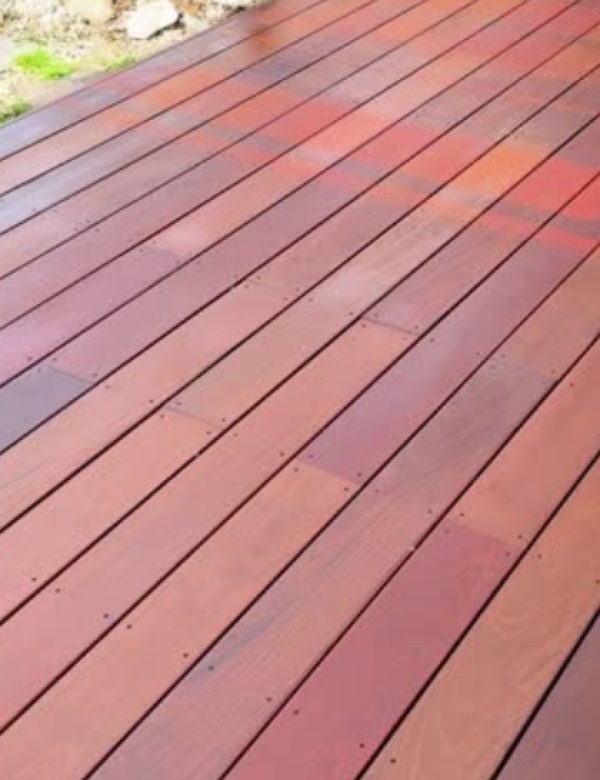
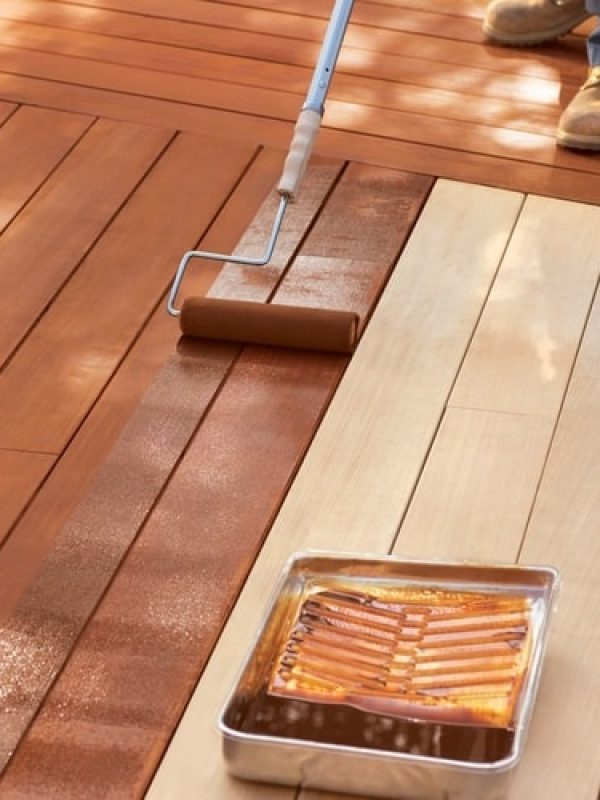
The prep work determines how long a stain job lasts. A well-applied stain on properly prepped wood can last three to four years in Central Texas conditions. The same product on poorly prepped wood might fail in eighteen months.
We start with a thorough pressure wash to remove mold, mildew, dirt, and loose old stain. For decks with significant old stain buildup or failed paint, we follow up with chemical stripping and sanding to restore the surface to clean, receptive wood fiber. A wood brightener treatment restores the wood’s natural pH and opens the grain for better stain penetration, which we apply to decks that need it.
Stain application follows once the wood has dried completely. In Central Texas, we schedule staining projects around temperature and humidity windows: staining below 50 degrees or above 95 degrees yields inconsistent results, and application in direct afternoon sun causes the product to flash-dry before it penetrates properly. We work around the conditions, not against them.
Application method depends on the deck type and product: hand-brushing for railings, balusters, and detail work; spraying for large open deck surfaces with back-brushing to ensure even penetration; rolling for flat surfaces where spraying isn’t appropriate. We don’t spray and walk away. Every sprayed surface gets worked with a brush or roller to push the product into the wood.
Staining is a maintenance service, not a structural fix. There are situations where a fresh coat isn’t the right answer.
If the deck boards have soft spots, are spongy underfoot, or show visible rot on the ends or underside, staining them protects the appearance but doesn’t address the structural failure. In those cases, deck repair in the right sequence is: fix what’s failed, then protect what remains.
If the framing is compromised, the ledger board shows moisture damage, or the footings have shifted, staining the surface. At the same time, the underlying structure continues to deteriorate, making the problem harder to detect and more expensive to fix later. Our inspection process catches these issues before we commit to a staining project, and we tell you what we find.
If the deck is so far gone that the cost of repair approaches the cost of replacement, deck replacement over staining is the honest recommendation. We’ve had that conversation. It’s not a sales pitch. It’s the same assessment we’d give if we were advising our own family.
Austin and Travis County are our largest staining market. Austin has a mix of older established-neighborhood decks in Hyde Park, Bouldin Creek, and Tarrytown that need careful prep work before staining, and newer HOA community decks in Mueller, Circle C Ranch, and Steiner Ranch on more standard maintenance cycles. Sun exposure varies significantly across the city: south-facing decks in full afternoon sun need restaining more frequently than east-facing decks with afternoon shade.
Avery Ranch and Cedar Park homeowners experience some of the most consistent UV exposure in our area. HOA communities in Cedar Park are particularly active in staining markets because appearance standards require decks to be maintained, and Avery Ranch design guidelines specify color ranges that align with the community aesthetic. We know those requirements.
Sun City and Georgetown bring active 55+ community homeowners who prioritize low-maintenance solutions and consistent scheduling. We regularly handle Sun City staining projects and understand the HOA process for exterior work in the community.
Teravista and Round Rock homeowners call us most often for restaining projects on composite decks and their wood framing elements, and for maintenance staining on cedar decks that have been through several Williamson County clay-soil seasons.
Rough Hollow and Lakeway bring unique staining challenges. Lakeway’s humidity from Lake Travis accelerates stain wear faster than inland Central Texas markets. Composite decks are dominant in Rough Hollow, but the wood pergolas and shade structures that accompany them require regular staining and sealing to withstand the lakeside climate.
Take a look at our staining portfolio to see the range of staining and sealing work we do throughout Central Texas.
Staining is often part of a larger project. We handle the full scope.
When a deck needs structural attention before it can be stained, our first-team deck repair assesses what needs fixing before any surface work starts. For new deck projects where staining is planned from the start, a new deck installation project or a new build-and-stain package that combines the build and the first stain coat into a single project gives homeowners the best initial protection for their new surface.
For most decks with semi-transparent stain, every two to three years is the right maintenance cycle. Decks in full afternoon sun may need attention every eighteen to twenty-four months. Decks with significant shade coverage can go three years or more. Water beading is the most reliable test: when water stops beading on the surface, it's time to restain, regardless of when it was last done.
It depends on the type and condition of the existing stain. Semi-transparent over semi-transparent works well when the old coat has faded but not failed. Solid stain over solid stain works when the previous coat is in reasonable condition. Stain over a failed or peeling coat doesn't hold well, so we strip and prep back to clean wood first in those situations. We assess the existing surface and tell you what's required before committing to a scope.
Transparent shows full wood grain with light UV and moisture protection, best for newer premium wood. Semi-transparent adds color while keeping grain visible and providing moderate protection, and is the most common choice for Central Texas decks in sound condition. Solid covers grain completely and offers maximum protection, best for older or heavily weathered decks. We recommend the right type based on your specific wood species, age, and condition.
Yes, but it requires the right product and timing. New pressure-treated pine needs to dry out for at least six months before staining, because the treatment chemicals need to cure fully and the initial moisture content needs to drop. We test the wood's readiness before applying the product, and we use formulations designed to penetrate through the treatment chemicals rather than sit on top of them.
Most residential deck staining projects take one to two days: one day for prep (pressure washing, stripping if needed, and drying) and one day for application. We schedule projects when the weather window is right, which in Central Texas means avoiding temperatures below 50 and above 95 degrees and keeping an eye on humidity levels during application.
Composite decking boards are not stained. They're manufactured with built-in color and UV protection and don't accept penetrating stains the way wood does. However, the wood framing, posts, railings, pergolas, and other wood elements that accompany composite decks can and should be stained. We handle those elements as part of a comprehensive maintenance visit.
Yes. New wood decks benefit from staining once the wood has had time to dry and settle after installation. For pressure-treated pine, that means waiting six months or more. For cedar and redwood, we can typically apply a first coat within four to six weeks of installation. We recommend building the first staining into the project plan from day one.
No. Deck staining and sealing is a maintenance service and doesn't require permits in Austin, Cedar Park, Georgetown, Round Rock, or Lakeway.
Apex Deck Builders has been staining and sealing wood decks across Central Texas since 2010. Veteran-owned, fully insured, and honest about what your deck actually needs. Call us or get a free on-site estimate to get started.