Composite decking has its advantages, and we install a lot of it. But for a meaningful number of homeowners in Central Texas, the warmth, grain, texture, and aging character of real wood is specifically what they want. A cedar deck that has spent five years in the Texas sun and turned the color of weathered driftwood before being brought back with a fresh coat looks like something that belongs on the property. A Trex deck never looks like that. At Apex Deck Builders, we’ve been building wood decks in Central Texas since 2010, and we know the species, installation requirements, and maintenance realities that determine whether a wood deck holds up here.
Schedule a wood deck estimate, and we’ll come out, walk your property, and have an honest conversation about which species makes sense for your yard, your HOA, and how much upkeep you actually want to do. We bring samples. We don’t push you toward any particular product. We match the material to the project.
Request A Free Quote
The three species that perform well in Central Texas each have distinct profiles. Getting the species right matters as much as getting the installation right.
Cedar is the wood deck material we install most often. Western red cedar has natural oils that resist moisture and insects without chemical treatment. It doesn’t need pressure treatment to hold up outdoors, which means it doesn’t contain the chemicals that can make some pressure-treated pine irritating to work around during installation. Cedar takes stain well in both oil-based and water-based formulations, holds color reasonably under Central Texas UV, and ages to a natural silver-gray when left unsealed. For homeowners in established neighborhoods who want a deck that looks like it grew with the property, cedar is the right call more often than any other species.
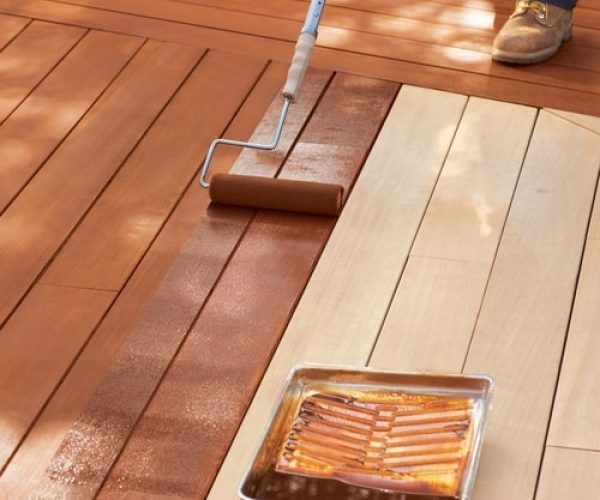
Redwood is the premium natural wood option when it’s available. Redwood’s heartwood has higher natural tannin content than cedar, which gives it better insect resistance and a richer initial color. In the Central Texas market, redwood is sometimes in limited supply and carries a higher material cost than cedar. For homeowners who specifically want the color profile and long-term performance of redwood and are willing to pay the premium, it’s a quality product that holds up well in this climate when properly sealed.
Pressure-treated pine is the cost-effective option that most production deck builders use as their standard material. It’s a southern yellow pine that has been infused with preservative chemicals under pressure to resist rot, insects, and moisture. Modern pressure-treated pine uses copper-based preservatives that are more stable than the older formulations. It performs well structurally and accepts paint and solid-color stain acceptably, but doesn’t accept semi-transparent stain as well as cedar or redwood because the treatment chemicals interfere with penetration. For projects where budget is the primary constraint and long-term natural appearance is less of a priority, pressure-treated pine is a reliable material.
Wood deck installation in Central Texas has specific requirements that differ from installation in a more moderate climate. The UV load, humidity cycling, and expansive clay soil all affect how a wood deck performs over time, and these factors need to be built into the installation itself.
Moisture barriers and flashing at the ledger board are non-negotiable. The ledger board is the single most vulnerable point in any attached deck. It’s the connection between the deck framing and the house framing, and if it traps moisture against the house, it rots both the deck structure and the home’s rim joist. We use appropriate flashing and sealant at every ledger installation, regardless of the species.
Fastener selection matters more in Central Texas than in most regions. The combination of moisture, clay soil acidity, and UV cycles accelerates hardware corrosion in outdoor wood structures. We use stainless steel or hot-dipped galvanized fasteners throughout. Standard electro-galvanized screws have a coating that fails in Central Texas conditions faster than most homeowners expect.
Gap spacing between boards is determined by the wood’s moisture content at installation. Freshly milled or pressure-treated wood is often still drying at the time of installation. Wood contracts as it dries, and decking boards installed tightly together at high moisture content will gap significantly as they dry. We assess moisture content and install it in the appropriate gap for the conditions, ensuring consistent spacing as the wood settles.
End sealing on cut boards reduces moisture entry at the most vulnerable points. Cut ends on any wood decking board expose end grain, which absorbs moisture faster than the face grain. We seal cut ends at butt joints, stair cuts, and any other termination where the end grain is exposed. It’s a detail that most installations skip, and it significantly extends the life of the surface boards.
We’re direct about this because it’s where the honest comparison between wood and composite comes to life.
A well-sealed cedar or redwood deck in Central Texas needs staining and sealing every two to three years to maintain its appearance and protective performance. A south-facing deck in full afternoon sun may need attention every eighteen to twenty-four months. A shaded east-facing deck can go three years or more. Pressure-treated pine on the same schedule. Staining and sealing your wood deck on that schedule keeps it looking right and prevents the moisture entry that causes structural deterioration.
If you maintain the schedule, a cedar deck in Central Texas can outlast a composite deck. Cedar, properly maintained in this climate, is a durable, long-lasting surface. If you don’t maintain it, the UV and moisture will work on it faster here than in a moderate climate, and a neglected wood deck deteriorates faster in Central Texas than almost anywhere else.
We’re honest about this at the estimate stage. For homeowners who travel frequently, have limited weekends for home maintenance, or want the lowest-maintenance possible outdoor surface, composite is likely the better long-term option. For homeowners who plan to maintain the deck properly and want the specific aesthetic and character of real wood, a wood deck is a great investment.
Wood decks are the right answer for specific contexts in our territory, and those contexts are worth naming.
Historic neighborhoods in Austin are the clearest case. Hyde Park, Bouldin Creek, Tarrytown, and Travis Heights are homes where the character composite decking doesn’t match. When we’re repairing or replacing a deck on a 1940s or 1950s bungalow in Hyde Park, the material decision almost always comes down to cedar or redwood, with a painted or natural-wood rail profile that fits the era of the house. Composite would look wrong on most of these properties.
Natural aesthetics in non-HOA markets are a strong driver. Homeowners with mature oak canopies, properties that back to Barton Creek or the Brushy Creek greenbelt, or lots where the natural Hill Country character is the dominant design context often want wood specifically because it fits where composite doesn’t.
Budget-constrained first builds, where the homeowner plans to replace or upgrade eventually, are a third context. Pressure-treated pine at lower material cost gets a functional, well-built deck on the property now, with the option to replace with composite or cedar at a later stage when budget allows.
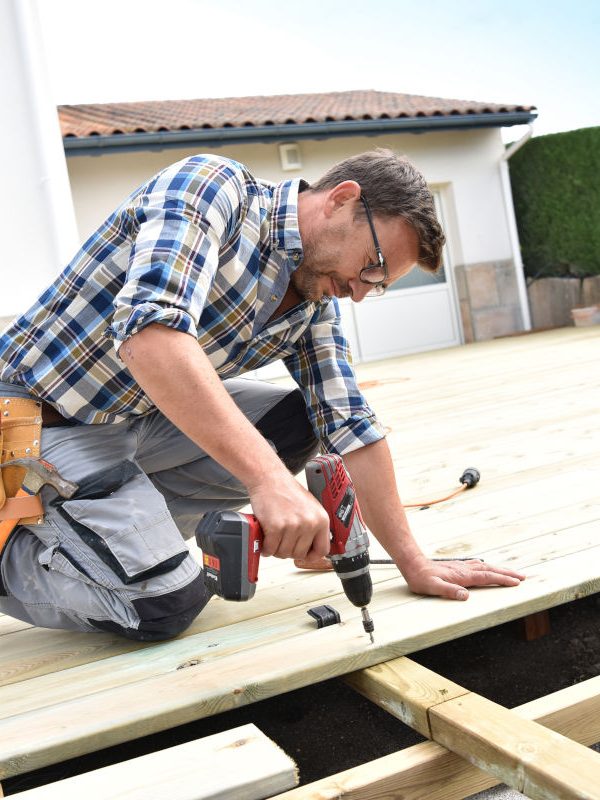
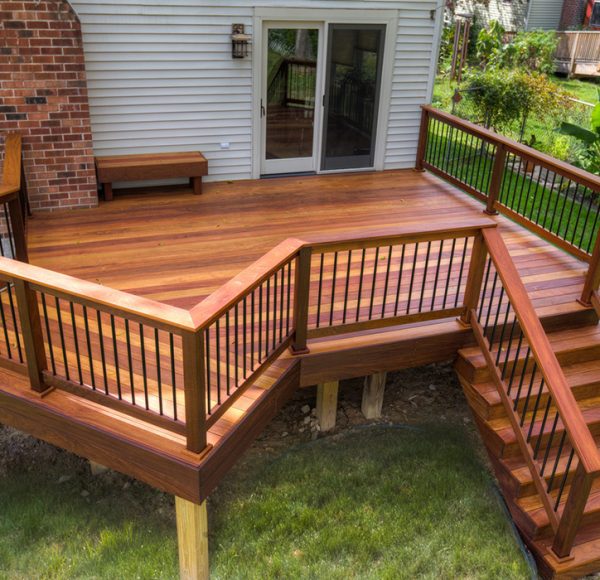
Wood deck railings are a design decision as much as a structural one. The railing system defines the deck’s visual profile at eye level and shapes how the finished build reads against the house.
A traditional wood railing with a 4×4 or 6×6 post, top rail, bottom rail, and square balusters is the classic profile for established neighborhoods in Central Texas. It matches the architecture of most pre-2000 homes and the landscape character of mature-tree properties. We build traditional wood rail in accordance with the current IRC code while preserving the aesthetic that makes the deck feel like home.
Cable rail is also available on wood decks and is a popular choice for view-oriented properties and more contemporary builds. A wood post system with cable rail infill gives the natural post material of a wood deck while providing the unobtrusive sightline of cable. It’s a combination that works well in Westlake, Barton Hills, and Lakeway, where the view matters.
Wood deck projects in Austin are concentrated in the established neighborhoods where the material makes the most design sense: Hyde Park, Bouldin Creek, Tarrytown, Travis Heights, and Barton Hills. We do a significant amount of repair and replacement work on aging wood decks in these neighborhoods, so matching the original material and aesthetic is part of the brief. New wood builds in South Austin and East Austin are also active parts of our territory for homeowners who want the natural look without the composite price point.
Wood deck builds in Cedar Park are most common in neighborhoods outside the primary HOA markets. Brushy Creek and the less restrictive communities in Cedar Park see solid demand for cedar builds among homeowners who prefer natural materials and don’t face HOA color or material restrictions.
Wood decks are common in older Georgetown neighborhoods and in rural residential areas north and east of the city. Georgetown Village and the established neighborhoods around downtown Georgetown have homes where cedar fits the character of the property in a way composite often doesn’t.
Wood deck projects in Round Rock are most active outside HOA-designated markets. Forest Creek and Stone Canyon homeowners sometimes choose cedar over composite for builds where HOA restrictions are less specific about material, and the natural look fits the community character.
Wood deck projects in Lakeway are less common than composite decks, given the dominance of HOAs in Rough Hollow and Serene Hills. However, cedar decks remain the right choice for homeowners in The Hills of Lakeway and other established Lakeway neighborhoods, where the traditional aesthetic complements the home.
Take a look at our wood deck portfolio to see the range of cedar, redwood, and pine builds we’ve completed throughout Central Texas.
Every wood deck build leads naturally to a few related services. Our wood deck design service handles the full design phase: site visit, layout planning, species selection, and HOA coordination where required. The full wood deck build handles construction from framing through final finish. After installation, our staining and sealing service for your wood deck protects the surface from the first Texas summer.
When an existing wood deck needs an assessment, our wood deck inspection service evaluates its structural condition and honestly tells you whether repair or replacement is the right path. When replacing your wood deck is the right choice, we handle the full demolition and rebuild. For homeowners who want to add shade coverage, wood pergola structures that match the deck’s species and profile create a cohesive outdoor space.
Cedar performs better over time in Central Texas conditions and gives a better natural appearance. It costs more upfront than pressure-treated pine but requires less maintenance to match cedar's performance. Pressure-treated pine is the right choice when budget is the primary constraint.
A cedar deck that is properly maintained with staining and sealing every two to three years can last twenty-five to forty years in Central Texas. Pressure-treated pine on the same maintenance schedule typically lasts 15 to 25 years. A neglected wood deck of either species deteriorates significantly faster in Central Texas than in a moderate climate due to UV and humidity cycling.
It depends on the HOA. Some communities specify composite by material or restrict wood deck colors in ways that effectively require composite. Others accept cedar and redwood without restriction. We review the HOA design guidelines for your community during the design consultation and tell you what's allowed before you select materials.
Every two to three years for most decks in our territory. South-facing decks in full afternoon sun may need attention every eighteen to twenty-four months. Shaded decks can often go three years. Water beading on the surface is the most reliable indicator. When water stops beading, it's time to restain.
Yes. Multi-level and elevated wood builds on sloped terrain are common projects across Cedar Park, Georgetown, and West Austin. The structural approach is the same as for flat-lot builds, with additional drainage planning built into the design for hillside properties.
Yes. Most attached wood deck builds and elevated structures require permits in Austin, Cedar Park, Georgetown, Round Rock, and Lakeway. Our team coordinates all permitting through our third-party permit partners.
In most cases, yes. Cedar matching for repair or extension work is generally achievable. For pressure-treated pine, grade and treatment level matching matters, and we assess existing boards before ordering new material to ensure consistency.
Yes, though availability is more limited than cedar, and the material cost is higher. For homeowners who specifically want redwood for its color profile and insect resistance, we can source it. We discuss availability and lead times at the consultation.
Apex Deck Builders has been building real wood decks across Central Texas since 2010. Veteran-owned, fully insured, and honest about what wood can deliver in this climate and what it requires from the homeowner who chooses it. Call us or schedule your free estimate to get started.