When a deck has reached the end of its useful life, the first order of business is getting rid of it properly. Deck demolition done right protects the house structure it was attached to, salvages footings and other foundation elements for reuse, and leaves a clean site ready for what comes next. When done wrong, it damages the ledger board connection, leaves debris and fasteners that create problems for the new build, and misses the opportunity to assess what can be carried forward. At Apex Deck Builders, demolition isn’t a separate service we hand off to a subcontractor. Our crews handle teardown as part of the replacement process, and we approach it the same way we approach the build: with a plan and with accountability for what we leave behind.
Schedule a demolition estimate, and we’ll come out, assess the existing structure, determine the scope of removal, and give you a clear picture of what the demolition includes, what gets hauled away, and what the site will look like when it’s done.
Request A Free Quote
A proper deck demolition is a structured deconstruction, not a tear-and-go. The sequence matters because each step creates the conditions for the next phase, whether that’s a new build or simply a clean yard.
We start by documenting the existing structure: what’s attached to the house and how, where the ledger board sits, what condition the rim joist behind it is in, how the posts connect to the footings, and whether the footings themselves are in a condition and location that works for the new build. This documentation shapes both the demolition sequence and the new build specification.
Decking boards and framing come off first. We remove deck boards systematically, extracting fasteners as we go rather than prying boards and leaving embedded hardware in the framing beneath. Joist hangers, beam-to-post connections, and ledger connections are disassembled rather than cut, where possible, to preserve the integrity of the house’s attachment points. When the ledger board connection must be severed, we protect the house framing behind it and assess the rim joist condition before installing the new ledger.
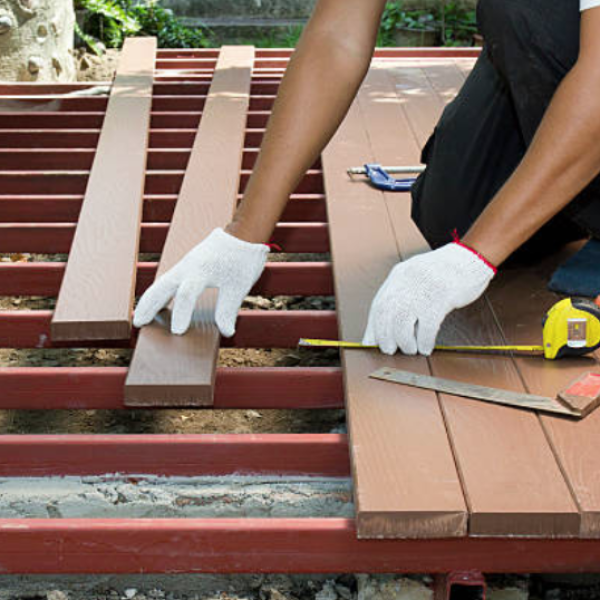
Post and footing assessment follows framing removal. Each post-to-footing connection is evaluated: is the footing in good condition and positioned correctly for the new layout, or does it need to be removed and replaced? Footings that are sound and in the right location for the new design stay. Footings that have cracked, shifted due to clay soil movement, or are positioned where the new design doesn’t need them, get removed. We don’t leave compromised footings in place because they become a problem for the new build.
Complete haul-away of all demolition material is part of every job. We remove all decking boards, framing lumber, hardware, and concrete debris from the site. You don’t need to arrange separate disposal. We leave the site clean, level, and ready for the next phase.
Not every demolition job is a complete removal. There are situations where partial teardown is the right approach.
A complete deck replacement involves full demolition: every board, every joist, every post, and the ledger connection, leaving only the footings that will carry forward into the new build. This is the most common scope when the deck has structural failure across multiple members or when the new design differs significantly from the existing layout.
A partial teardown removes the surface boards and some or all of the framing, while leaving the existing post-and-footing system in place. This is appropriate when the foundation is sound, the layout is staying the same, and the objective is to replace the surface and framing while reusing the structural base. We assess the existing framing condition before committing to a partial teardown scope. If the existing joists have moisture damage, pest damage, or are approaching the end of their structural life, a partial teardown that leaves them in place is a short-term solution.
Selective board replacement is not technically demolition; it’s repair. When isolated boards are failing, but the rest of the structure is sound, our repair-before-demolition assessment honestly tells you whether you’re at the repair threshold or the full replacement threshold. We’ve had both conversations. The goal is the right call for the specific structure, not the largest scope of work.
The factors that make full demolition the right answer are the same factors that make replacement more cost-effective than repair.
Framing failure across multiple members. When rot, pest damage, or moisture infiltration has affected multiple joists, beams, or posts, rebuilding member by member is as costly as full replacement. At that point, a full teardown and new build gives you a completely new structure rather than a patched-together repair.
Footing failure. Clay soil movement in Williamson County and Travis County can shift footings over time. A footing that has cracked, heaved, or moved past the point of repair can’t be corrected without removal and replacement. When footings have failed, the structure above them needs to come off to access and repair the foundation.
Design change. When the homeowner wants a different layout, a different size, or a multi-level structure that requires different post placement than the existing deck, the old deck comes off regardless of its condition. You can’t redesign on top of a structure that was built for a different layout.
Age and cumulative condition. A deck that has been through enough Central Texas seasons to show signs of age across the full structure, even if no single component has catastrophically failed, is often more efficiently replaced than maintained. We give you that assessment at the estimate stage.
For projects where demolition and rebuild is the right path, we handle the full scope: demolition, foundation assessment, permit coordination through our third-party permit partners, and complete new installation.
The footing assessment after demolition is one of the most important parts of the process.
Existing footings that are in sound condition and correctly positioned for the new design can carry forward. This saves time and cost compared to removing and replacing concrete footings. We test each footing for structural integrity and confirm its position relative to the new-build layout before deciding which footings to keep and which to remove.
In Central Texas, clay soil movement is the most common cause of footing problems in existing decks. A footing poured at the correct depth for the initial installation may have been pushed by soil expansion over the years due to wet-and-dry cycles. We probe the footing depth and test for lateral movement before committing to reuse. A footing that has moved is a footing that will continue to move.
For the new build, we size and pour footings to the depth and diameter required for the post load and the soil conditions at the specific site. Central Texas clay soil requires a greater footing depth than the IRC base specification assumes for stable soil. We design according to what the soil actually requires.

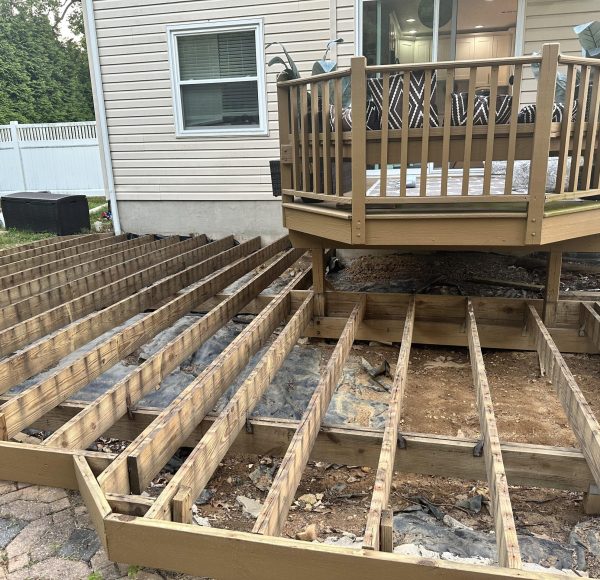
When a deck has an attached pergola, patio cover, or other shade structure, the demolition scope must address the entire connected structure.
Attached pergolas share the load with the deck framing and the house ledger. Removing the deck while leaving an attached pergola in place isn’t structurally possible. The fully connected structure comes off together. For freestanding pergolas adjacent to the deck, we assess whether they’re structurally independent or connected to the deck framing before determining the demolition sequence.
Pergola removal as part of a deck demolition project is included in our assessment and estimate. If the pergola is in better condition than the deck and the homeowner wants to preserve it, we discuss whether that’s structurally feasible before the demolition begins. In most cases, when the deck structure is at the end of its life, the pergola it’s attached to has been subjected to the same conditions and carries the same assessment.
Austin demolition projects include a significant volume of historic neighborhood deck removal in Hyde Park, Tarrytown, and Bouldin Creek, where original decks from the 1970s through the 1990s are reaching the end of their life. We handle these demolitions carefully to protect the original house framing and siding, which, in older Austin homes, requires more care than typical production construction.
Cedar Park demolition projects are concentrated in established neighborhoods where first-generation decks built in the early 2000s are now at or near replacement age. Hillside lots in Brushy Creek and Crystal Falls add drainage and slope considerations to the demolition process.
Georgetown demolition work includes Sun City composite deck teardowns, where homeowners are replacing aging installations, and the removal of older Georgetown Village decks ahead of new cedar or composite builds.
Round Rock demolition projects in established neighborhoods like Forest Creek and Stone Canyon typically involve removing the first-generation deck before rebuilding it with a composite or cedar deck.
Lakeway demolition projects are most common on original Lakeway properties where decks built in the 1990s and early 2000s are at replacement age, and on premium Rough Hollow and Serene Hills builds where a previous owner’s deck doesn’t match the new owner’s vision.
Take a look at our demolition projects to see the range of deck removal and site preparation work we’ve completed throughout Central Texas.
For most homeowners who call us for demolition, the goal isn’t just to remove the old deck. It’s to be ready for what comes next.
A new deck design is developed in the new deck design phase before demolition begins, so we know exactly which footings to carry forward, what post placement the new design requires, and what site prep the new build needs. Running design and demolition in parallel reduces the gap between teardown and rebuild. For homeowners who want to composite replacement after demo or a wood replacement after demo, the material selection is part of the same conversation as the demolition scope.
Our new railing system and all other new-build elements are also specified before demolition begins, so the new build can proceed immediately when the site is ready.
Deck demolition is directly connected to the full replacement and new-build process. Our demolition and rebuild service handles the full scope from teardown through new build as a single project. For homeowners unsure whether their deck needs repair or demolition, our repair-before-demolition assessment provides a clear, honest answer at no charge.
Yes. We demolish and remove decks regardless of who built the original structure. Our assessment before demolition focuses on the current condition, not the building's history.
It depends on the scope and city. Full deck demolition, particularly for attached decks, may require a demolition permit in some jurisdictions. Demolition performed as part of a replacement project is typically covered under the replacement permit. Our team coordinates all permitting through our third-party permit partners and confirms the permit requirements for your specific project.
Most residential deck demolitions are completed within one to two days, depending on the size and complexity of the structure. Decks with attached pergolas, patio covers, or built-in features take longer to build. Site cleanup and haul-away are part of the same timeline.
Sometimes. We assess each footing after the framing comes off. Footings in good condition and correctly positioned for the new layout can be carried forward. Footings that have moved, cracked, or are in the wrong location for the new design are removed and replaced.
Yes. Complete haul-away of all demolition debris, including decking boards, framing lumber, hardware, and concrete, is included in every demolition project we do.
We assess the rim joist and house framing at the ledger connection during demolition. If there is moisture damage or rot behind the ledger, we address it before installing the new ledger board. We never install a new ledger board against compromised house framing.
Yes, when the framing is in sound condition. A partial teardown that removes boards while leaving joists and beams in place is appropriate when the framing passes our structural assessment. We assess the existing framing condition honestly before committing to a partial scope.
Yes. Hillside and elevated deck demolition is more complex than flat-lot removal because of access and structural sequencing on sloped terrain, but it is a standard project for our team.
Apex Deck Builders has been handling deck demolition and removal across Central Texas since 2010. Veteran-owned, fully insured, and honest about what the structure needs. Call us or schedule your free estimate to get started.