
The lifespan of a wood deck in Central Texas depends on four things: the species of wood, the quality of the installation, the maintenance the homeowner commits to, which in Central Texas means regular staining and sealing, and the specific conditions of the site. A cedar deck installed with proper footings, correct moisture barriers, and stainless hardware by a crew that knows what they’re doing can last thirty years or more in Austin or Georgetown. The same materials installed with undersized footings on clay soil, with electrogalvanized hardware and no proper flashing at the ledger board, may show structural problems within five years. The species and the calendar matter less than people expect. The installation quality and the maintenance calendar matter more.
This post explains what each variable contributes to deck longevity in Central Texas specifically, so you can make the decisions that actually extend the life of your deck.
Species Lifespans in Central Texas Conditions
Pressure-treated pine under good care in Central Texas runs fifteen to twenty-five years. When the surface deteriorates faster than expected, our deck repair service team assesses whether the underlying frame is sound or if full replacement is needed. Under excellent care with consistent staining and sealing every two years and annual inspection for fastener corrosion and board-end rot, it can push toward the higher end of that range. Under deferred maintenance, the surface boards may need replacement within 10 years, while the underlying frame remains sound.
Cedar can run for 20 to 30 years under good maintenance conditions in Central Texas. The natural oils in cedar resist moisture and insects without chemical treatment, which gives it better baseline performance than pine under the same UV and humidity conditions. Cedar that’s been maintained well looks significantly better at the fifteen-year mark than comparable pine. Cedar, with neglected maintenance, weathers faster than pine under the same neglect, though it tends to recover better when maintenance resumes.
Redwood performs similarly to cedar in Central Texas when properly maintained. Availability in this market is limited compared to cedar, but the performance profile is comparable, with slightly higher inherent resistance to insects and moisture.
Tropical hardwoods like ipe, cumaru, and tigerwood are the most durable natural wood option available and the most expensive. Ipe, properly installed, can last 40 years or more under Central Texas conditions. The density that gives tropical hardwoods their longevity also makes them challenging to install and very hot underfoot in summer, which is why they’re not the dominant choice in our market despite their durability.
Composite decking from major brands carries manufacturer warranties of twenty-five to thirty years. The composite deck lifespan in Central Texas conditions meets that range when the framing is properly built and maintained. Composite eliminates the surface maintenance variable that determines so much of wood deck longevity, which is its primary practical advantage in a climate that demands consistent maintenance from wood decks.
Why Installation Quality Determines Lifespan More Than Species
The quality of the deck installation matters more than the species. A properly installed deck of any species will outlast a poorly installed deck of a premium species. The installation variables that most affect long-term performance are the ones that aren’t visible after the deck is finished.
The ledger board connection to the house is the single most failure-prone element in an attached deck. A ledger without proper flashing traps moisture against the house’s rim joist, rotting both the deck framing and the home’s structural framing. This failure is invisible until it’s serious. We install appropriate flashing and sealant at every ledger connection, regardless of the decking species on top.
Footing depth and design are the second-most critical installation variables in Central Texas. The expansive clay soil in Williamson County and much of Travis County moves seasonally. A footing that isn’t deep enough, wide enough at the base, or properly designed for the site’s specific soil conditions will shift. That shifting transfers stress to the framing and eventually to the deck surface. The visible symptoms appear years after the decision to install was made.
Fastener selection determines how long the hardware holds before corrosion creates structural weakness. Standard electrogalvanized screws have a zinc coating that fails in Central Texas outdoor conditions faster than most homeowners expect. We use stainless steel or hot-dipped galvanized hardware throughout. It costs more at installation and adds years to the structure’s functional life.
Board spacing at installation determines whether the deck drains properly throughout its useful life. Boards installed too tightly hold moisture between them. Boards installed too wide look wrong and create trip hazards. Freshly pressure-treated pine installed with proper spacing for its moisture content at installation time will settle into the correct gap as it dries. Installing it too tightly because it looks right wet is one of the most common installation errors that accelerates surface deterioration.
Maintenance: What the Schedule Actually Requires
For wood decks in Central Texas, the maintenance calendar is not optional. It’s the variable that most directly separates the thirty-year deck from the fifteen-year deck of the same species.
Annual inspection is the minimum. Walking the deck in spring, checking for soft spots underfoot, testing railings for movement, checking fastener heads for rust staining, and checking under the deck at the ledger connection and post bases takes about 30 minutes and catches problems when they’re inexpensive to fix.
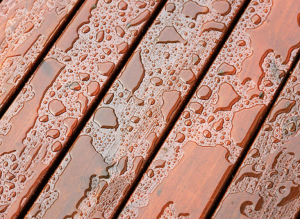
Wood deck staining and maintenance on a two- to three-year cycle is the surface protection schedule for most Central Texas decks. South-facing decks in full afternoon sun run closer to the two-year end of that range. Decks with significant shade coverage can stretch toward three years or slightly beyond. The water bead test is more reliable than the calendar: when fresh water no longer beads on the surface and instead sits flat against the wood, the surface seal has failed.
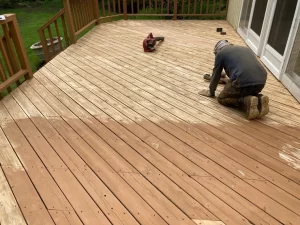
When the maintenance schedule slips to the point where a fresh stain coat will no longer restore the surface, a professional cleaning and deck restoration process can often bring a neglected wood deck back to serviceable condition. We handle that as a standalone service or as prep work before a staining project.
Signs Your Wood Deck Is Approaching Replacement
Not every problem is a maintenance issue. Some are structural indicators that the deck has reached the end of its serviceable life.
Soft or spongy areas underfoot indicate rot in the decking boards or the framing below them. A deck repair assessment determines whether the damage is isolated or structural. Soft spots at the board level can sometimes be addressed with selective replacement. Soft spots indicating joist or beam rot require a structural assessment. A deck inspection by someone who will actually get under the structure and probe the framing is the only way to know which problem you’re dealing with.
Rails that move when you apply lateral pressure pose a safety issue and require a railing inspection before the deck is used again. Railings on elevated decks are not optional safety features, and any failing rail system must be addressed before the deck is used.
Significant level changes across the deck surface, especially changes that weren’t there when the deck was new, indicate footing movement. On a clay-soil site in Georgetown clay-soil decks territory or elsewhere in Central Texas, this is worth investigating immediately.
If multiple issues appear together, the deck replacement service may be more cost-effective than repair. That decision needs a structural assessment. We give that assessment at the free deck inspection, honestly, based on what’s actually there.