Deck failures in Central Texas that aren’t due to poor surface maintenance are almost always due to poor foundation design. And the most common cause of poor foundation design in this region is failing to account for soil conditions. The expansive clay soil that runs through most of Williamson County and much of Travis County is one of the most active soil types on which a deck foundation can be built. It swells when it absorbs moisture and contracts when it dries. It does this repeatedly, through every wet spring and dry summer. And a deck foundation built without accounting for that movement will show the effects over time in ways that start subtle and eventually become expensive.
This post explains what expansive clay does to deck footings, where in Central Texas it’s the most active, and what proper foundation design looks like in this soil type. Every foundation-first deck installation we complete starts with a soil assessment before a single footing spec is written.
What Expansive Clay Soil Actually Does
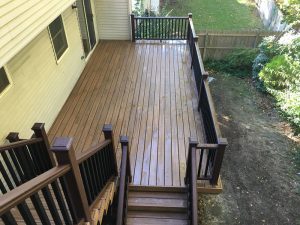
Expansive clay soil is defined by its behavior in response to moisture. When clay absorbs water, the mineral structure swells. When it dries, it contracts. In Central Texas, this cycle happens seasonally and sometimes more frequently depending on rainfall patterns. A wet spring drives significant moisture into the soil. A dry July pulls it back out. The soil surface can rise and fall by several inches over the course of a year in areas with high clay content.
A deck footing sits in the ground and is surrounded by this soil. Suppose the footing is shallow enough to be in the zone where the soil is actively swelling and contracting; the soil movement transfers directly to the footing. The footing moves. The post above it moves. The framing above the post moves. And the deck surface above the framing reflects that movement as level changes, gaps between boards, and eventually cracked or loose connections.
This process is slow. A deck that was installed with undersized footings on Williamson County clay won’t show obvious problems in the first year. By year three or four, a level change might be visible across the deck surface. By year seven or eight, the framing connections may be loosened by accumulated movement, and the railings may feel unstable. By year ten or twelve, the structural problems can be significant.
Where Clay Soil Is Most Active in Central Texas
Not all of our service territory sits on clay. The soil conditions in Central Texas are geographically variable, and understanding where clay is most active helps homeowners in affected areas know what to expect.
Georgetown and the north Williamson County corridor sit on some of the most active clay soil in our territory. The Blackland Prairie that runs through this area is dominated by high-plasticity clay that swells and contracts significantly with changes in moisture. Sun City Georgetown and Georgetown Village both sit on this soil type, and we design foundations for Georgetown projects with that movement range in mind.
Round Rock and Cedar Park are also largely clay-soil markets, though the clay content and activity level vary by specific location within each city. Teravista, Paloma Lake, and the neighborhoods in the northern Cedar Park corridor are on soils that require deeper footings than the IRC base code assumes for stable soils.
Central and east Austin, east of MoPac, are primarily clay soil markets. The neighborhoods in this zone, from East Austin through the Mueller area, have soil conditions that require careful footing design. West Austin, including Westlake and Barton Hills, transitions to limestone and caliche. The soil conditions there are more stable, but present different challenges for footing installation because limestone is harder to drill.
Lakeway limestone, which builds in the Lake Travis corridor, sits on limestone rather than clay. The foundation design challenges in Lakeway are different: the substrate is harder to penetrate, drilling is more expensive, and drainage design for hillside lots adds engineering complexity. But the seasonal movement that makes clay so problematic isn’t a factor in Lakeway.
What Proper Foundation Design Looks Like on Clay Soil
The response to expansive clay in deck foundation design is to place the footings below the zone of active soil movement and to provide a sufficient base diameter to resist the uplift and lateral forces generated by the clay.
Footing depth in Central Texas clay-soil markets needs to reach below the seasonal moisture zone. The IRC base minimum footing depth is set for general soil conditions and is often insufficient for high-plasticity clay. We design footings for the specific soil conditions at each site rather than to a standard specification.
The footing base diameter matters as much as the depth. A narrow footing that reaches adequate depth still has limited bearing capacity and resistance to the lateral forces exerted by clay soil during swelling cycles. Bell-bottom footings that are wider at the base than at the top distribute the load more effectively and resist uplift better than straight-sided columns of the same depth.
Concrete quality and curing at the footing are other variables that affect long-term performance. Concrete poured in wet clay soil during a rain event may be diluted by water entering the hole before it sets. We take the conditions at the time of pour seriously and won’t pour footings into saturated, collapsing holes.
Signs Your Deck Foundation May Be Failing
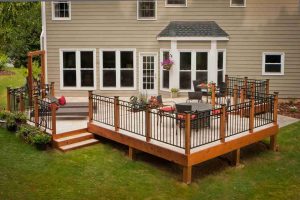
If your deck was built on clay soil in Central Texas without an appropriate foundation design, some signs indicate foundation movement is occurring or has occurred.
Level changes across the deck surface are the most visible indicator. A deck that was flat at installation and now has a noticeable slope, or a corner that has risen or fallen relative to the rest of the structure, is telling you that one or more footings have moved.
Gaps between deck boards that have widened or narrowed unevenly may indicate that the frame beneath them has racked or twisted in response to footing movement. This is different from normal wood shrinkage, which tends to affect all gaps somewhat uniformly.
Railing posts that feel loose or that have changed their vertical alignment are often the first place homeowners notice footing movement, because the railing magnifies the angular change that occurs when a post base shifts.
Cracks or separation at beam-to-post connections or at joist hanger connections that weren’t there when the deck was new indicate that the structural members have been moved relative to each other by something below them.
If you see any combination of these signs, a deck inspection for foundation issues is the right first step. In some cases, the footings can be stabilized, and the frame relevelled. In others, a full deck rebuild after failure is the more cost-effective path.
How We Design for Clay Soil in Central Texas
Every Apex deck build starts with a site assessment that includes soil evaluation. For projects in Georgetown, Round Rock, Cedar Park, and clay-soil Austin neighborhoods, we design the footings for the soil conditions at that specific site rather than defaulting to a standard spec.
Austin area foundation builds in east and central Austin, and gets footing designs that account for the clay-soil conditions typical of those neighborhoods. Cedar Park clay soil builds follow the same approach for the rolling terrain and clay soil typical of that market.
Georgetown, Williamson County, and Round Rock footing design applies the same principle: assess first, design to the actual soil conditions, not to the minimum the code requires.
Our custom foundation design conversation at the estimate stage covers the site soil conditions, what the footing design will look like, and how that design accounts for the soil movement range we can expect at your property.
Get a foundation assessment at no charge. We come to your property, walk the site, and tell you what the soil conditions require for a deck that holds its position for the next twenty years.
Frequently Asked Questions About Clay Soil and Deck Foundations