Sometimes the right answer isn’t to fix what’s there. A deck that’s been through fifteen years of Central Texas sun, clay soil movement, and seasonal moisture cycling can reach a point where the underlying structure has failed so broadly that selective repair is not feasible. When that happens, replacement isn’t a setback. It’s the moment you get to build what you actually want. At Apex Deck Builders, we handle the full scope: demolition, foundation assessment, new design, and complete installation. What goes up is better than what came down.
Schedule a replacement consultation, and we’ll come out, inspect the existing structure, and honestly tell you whether you’re at the repair or replacement threshold. We’ve had both conversations. The goal is to give you the right answer, not the bigger job.
Request A Free Quote
Not every failing deck needs to be replaced. But some do, and knowing the difference matters. The factors that push a deck past the repair threshold in Central Texas are almost always structural.
When rot has worked its way into the joists, beams, or posts across multiple members, selective repair becomes an exercise in replacing everything piece by piece at a higher total cost than starting fresh. When footings have failed or shifted significantly due to clay soil movement, repairing the surface while leaving compromised footings in place just means you’ll be dealing with the same problem again in a few years. When the ledger board connection to the house has been compromised by moisture infiltration and the rim joist behind it is also damaged, replacing the connection point often makes more sense than repairing it.

Age alone isn’t a replacement indicator. We’ve repaired twenty-year-old decks with solid frames and replaced twelve-year-old decks with compromised foundations. What matters is the structural condition, not the birthday. Our deck repair assessment process tells you which side of that line you’re on before any work starts.
There’s also a legitimate non-structural reason to replace: the existing deck no longer serves the homeowner’s needs for the space. A deck built for a previous lifestyle, a layout that doesn’t accommodate how the family actually lives outside, or a design that has become more problem than asset. In these cases, replacement is a choice rather than a necessity, and it’s a valid one.
Replacement is the best time to reconsider your decking material, because you’re already starting from scratch. The decision you make now will affect how the deck performs, how much maintenance it requires, and how it looks for the next fifteen to twenty-five years.
Many homeowners who are replacing an older wood deck choose to upgrade to a composite deck. Trex, TimberTech, and Fiberon composite boards don’t require annual refinishing, resist UV fading that damages unprotected wood in Central Texas summers, and don’t absorb moisture that accelerates rot during our humidity cycles. The upfront investment is higher than that of pressure-treated pine, but the long-term maintenance cost is significantly lower. In HOA communities where appearance standards are enforced and time for ongoing maintenance is limited, composite is the most popular choice we see.
Wood remains the right choice for many replacement projects. Wood deck replacement in cedar, redwood, and pressure-treated pine gives you a natural warmth that no composite product has fully replicated. Cedar’s natural resistance to moisture and insects makes it a particularly good choice for Central Texas conditions when properly maintained. For homeowners in Austin’s historic neighborhoods or in communities where the aesthetic strongly favors natural materials, wood is often a better fit for the home’s character.
The choice between wood and composite also affects the foundation and framing specs. Composite boards have different expansion and gap requirements than wood. We account for those specs in the structural design, not as an afterthought at the surface install stage.
Replacement gives you a clean slate. The old deck’s layout doesn’t have to constrain the new one. This is the moment to fix what wasn’t working and add what was missing.
Most of the replacement projects we do involve at least some layout change. A deck that was too small for how the homeowner actually entertains. A stair location that never made sense for the yard. A surface that was level when it should have been terraced to work with the slope of the lot. A single-zone deck that should have been two zones with a clear separation between cooking and lounging.
When you redesign the layout, you also get to address things the original deck never had. Upgraded railing systems in cable, glass, or aluminum that improve sightlines and match a more current aesthetic. Shade integration with an attached pergola or covered section makes the deck usable through summer afternoons. Built-in seating that eliminates the need to move furniture every time you use the space. Electrical access for outdoor lighting or kitchen equipment that the original deck wasn’t wired for.
We design the replacement as a complete project, not just a surface swap.
We start the same way we start every project: with a site visit and a straight assessment. We walk the existing deck, document the structural condition, assess the foundation, and talk through what you want the replacement to accomplish. Nothing moves forward until we’ve seen the actual space and you’ve approved a plan.
Our crew handles demolition and haul-away. We completely remove the existing structure, inspect the footings and foundation, and determine what to carry forward and what needs to be replaced. In most cases, existing footings can be reused if they’re in sound condition and properly located for the new design. When they can’t, we remove and replace them to the required depth for the new structure.
Our third-party permit partners handle permit coordination. Deck replacement almost always triggers permit requirements, and the permit process in Austin, Cedar Park, Georgetown, Round Rock, and Lakeway each has its own timeline. We build those timelines into the project schedule from day one so they don’t come as a surprise.
Construction follows the approved plans and the approved design. Our crew handles every phase in-house. We don’t subcontract the build. A project manager stays on site, communicates updates throughout, and won’t call the job complete until you’ve done the final walkthrough.
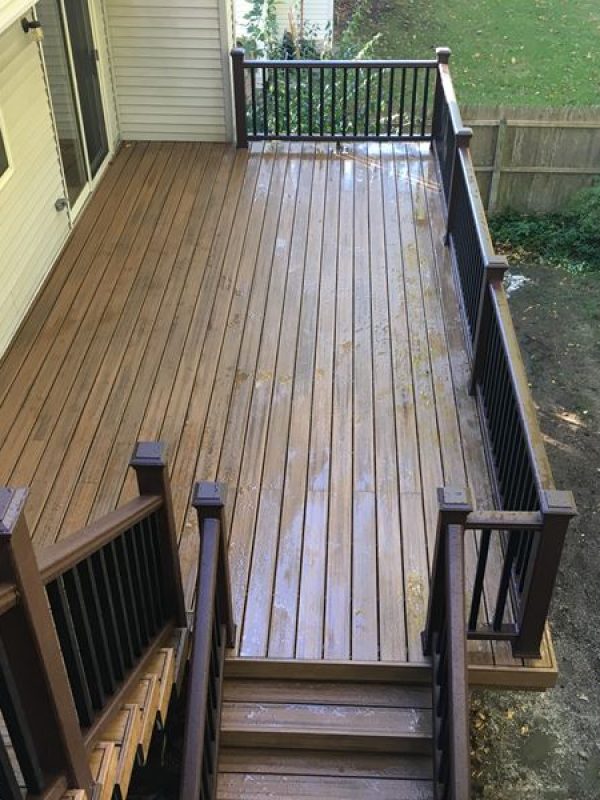
Austin area replacement projects cover the full range of what the city offers: historic homes in Hyde Park and Tarrytown where the replacement deck needs to match the character of the original, hillside properties in Westlake and Barton Hills where multi-level designs take advantage of elevation, and HOA communities in Mueller and Circle C Ranch where design standards are part of every project.
Cedar Park area replacements frequently involve decks on hillside lots in Crystal Falls and Brushy Creek, where the original footings shifted due to drainage issues on sloped terrain. The replacement design almost always includes drainage planning as part of the foundation spec.
Georgetown area replacement work includes a significant amount of Sun City composite replacement projects, where homeowners are ready to step up from older wood decks to low-maintenance composite builds that fit the active lifestyle the community is built around.
Round Rock-area replacements in Teravista, Forest Creek, and Paloma Lake often involve clay-soil footing failures that render the original deck unsafe. The replacement design accounts for the soil conditions from the foundation up.
Lakeway area replacement projects in Rough Hollow, Serene Hills, and The Hills of Lakeway involve premium builds on hillside lots with lake views. Multi-level designs, cable rail systems, and high-end composite products are the norm in this market.
Take a look at our replacement portfolio to see the full range of replacement and redesign work we do throughout Central Texas.
Replacement often leads to a broader conversation about the outdoor space. We handle the full scope.
For homeowners who want to expand beyond the deck itself, a shade integration project with an attached or freestanding pergola can be designed as part of the replacement and built simultaneously. A full outdoor living redesign that brings decking, shade structures, lighting, and built-in features together as a single project gives you the most cohesive result and the cleanest build sequence. After the new deck is complete, our staining-after-replacement service protects wood decks from the start and helps new cedar and pressure-treated pine perform better through the first Texas summer. When the replacement is complete, but you’re ready to build new, our deck-build team handles additional structures on the same property.
The frame is the deciding factor. Surface damage and isolated component failures almost always favor repair. Widespread framing rot, failed footings across multiple points, or a ledger board connection that has compromised the house framing behind it typically favor replacement. We give you a straight structural assessment at the free consultation, so the decision is based on what's actually there.
Yes, in most cases. Deck replacement triggers permit requirements in Austin, Cedar Park, Georgetown, Round Rock, and Lakeway because it involves structural work and new ledger connections. Our team coordinates all permitting through our third-party permit partners, so you don't have to navigate city offices on your own.
Yes, and we encourage it. Replacement is the right time to fix anything the original deck got wrong and add what it was missing. Layout changes, material upgrades, new railing systems, shade structures, and electrical access for outdoor lighting or kitchens can all be incorporated into the replacement project from the design stage.
Most residential deck replacements take one to two weeks from demolition through final walkthrough, depending on size, design complexity, and materials. Permit timelines factor into the overall schedule, so we account for them from day one.
Sometimes. We inspect existing footings as part of the demolition process. If they're structurally sound and correctly positioned for the new design, we reuse them. If they've shifted, cracked, or don't align with the new layout, we remove and replace them.
Both are good choices in Central Texas when installed correctly. Composite requires less maintenance over time and handles heat and humidity better than unfinished wood. Wood gives a natural look and warmth that many homeowners prefer, and it's often the better fit for historic homes or neighborhoods with a natural aesthetic. We bring material samples to the consultation and walk through the trade-offs for your specific situation.
We handle all demolition and haul-away as part of the replacement scope. You don't need to arrange separate disposal. We completely strip the structure, inspect the foundation, and leave the site clean before the build phase begins.
Yes. We replace decks regardless of who built the original. Our assessment focuses on the current structural condition, not the building history.
Apex Deck Builders has been replacing decks across Central Texas since 2010. Veteran-owned, fully insured, and honest about what your deck actually needs. When you’re ready to start fresh, call us or schedule your free estimate.